The Royal Game of Ur has had an interesting history, showing up Both in the Tomb of Pharaoh Tutankhamun and carved into one of the gate sentinels at the Place of Sargon the second of Khorsabad.
The rules, having been lost to time, were re-discovered in the 1880s on a tablet (dated to 177 BCE) carved by the Babylonian scribe Itti-Marduk-Balátu. That being said, it wasn’t until the 1980s that the tablet was translated by Irving Finkel, Curator of the British Museum, resulting in the games second life.
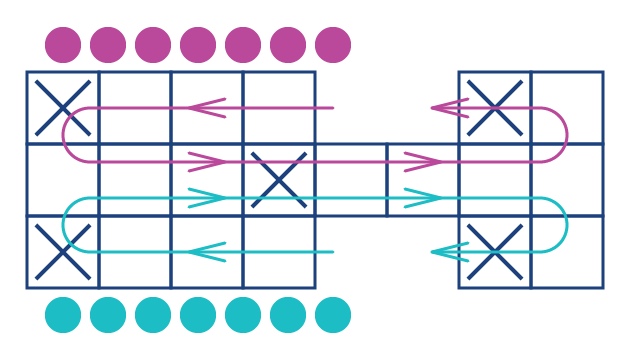
The rules of the game are relatively simple.
Each player begins with 7 counters off the board.
4 pyramid shaped die (similar to a d4), with two of their 4 corners coloured differently, are rolled to generate a value between 0 and 4. The value generated is the distance the player who rolled may move.
Should a player counter land on a rosette tile (represented by X in the illustration above) said player may roll a second time, otherwise; it is now the second players turn.
Should a player counter land on a tile that has an opponent’s counter already on it, the opponent’s counter is removed from the board and sent back to the beginning. Due to the layout of the board, this is only possible along the central row of the board. If a player counter is on a rosette, it cannot be removed.
The aim is for a player to move all of their counters from one end of the board to the other, however an exact roll in necessary to move said players piece off the end of the board.
The first player to do so wins.
My first instinct with this game was to make a mad dash for the end, however a somewhat defensive strategy proved to be more useful. Ensuring your opponent doesn’t reach the end is as important as reaching it yourself.
The game is interesting, and rather enjoyable. It manages to be challenging without being infuriating. It is defiantly one I plan to continue playing.
 K00253257 - College Blog