Mancala, originating from the Arabic word naqala (to move), is a game with a muddled history. While most archaeological evidence points to the game originating in Yehe (Ethiopia) between 500-700 CE; some claim the game may date back as far as 6000 BCE, originating with the Nabataeans in Jordan.
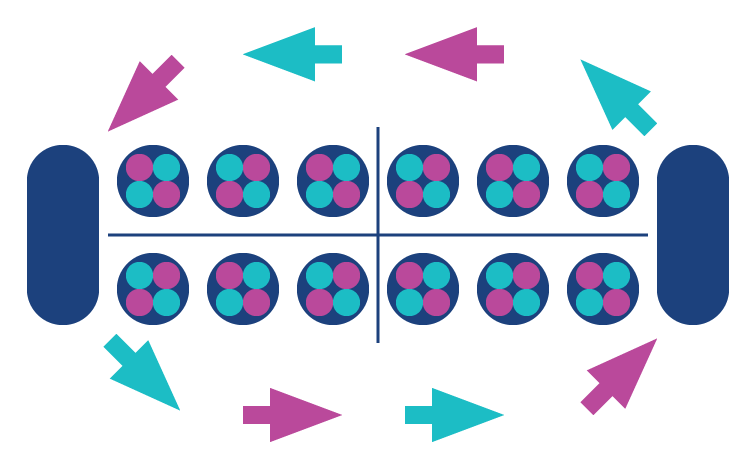
The game consists of a board containing 2 rows of 6 cups, with two large wells at either end named Mancalas, and 48 counters.
A player may move the counters in any cup on their side to the right, depositing 1 counter in each subsequent cup and continuing around the board. Should a counter be deposited in a players Mancala, this counter will remain there until the end of the game.
When a player makes a move; if the last counter deposited lands in their own Mancala they may move again.
If the last counter lands in an empty cup, the player moves the counter from said cup and from the adjacent cup on their opponent’s side of the board directly into their own Mancala.
The game ends when one of the players clears all the cups on their side of the board. Should this happen, their opponent adds all counters that are still in play on their side of the field into their own Mancala. The counters are then counted.
The player with the most counters in their Mancala at the end of the game wins.
This is a very easy game to pick up. That being said, the strategies you can have it this game are quite varied. You may choose to horde most of your counters in an attempt to cash them all in at the end of the game, which may result in a high reward, but may also backfire if you run out of other possible moves.
You may also choose to overload you opponent side of the table, allowing to steal back the counters in bulk over the next few round. This, however, may result in a better outcome for you opponent should you run out of counters with which to steal.
The game can be played both offensively and defensively, a decision best made after seeing your opponents playstyle. This game rewards flexibility and can easily be thrown with one false move.
This is a great game for a quick playthrough, making it easy to learn and improve.
 K00253257 - College Blog