The oldest depiction of the game Senet (meaning gateway or passageway) was discovered in the tomb of Rashepes, dating to roughly 2500 BCE. That being said, the game appears to have also been mentioned in Hieroglyphics in the tomb of Merknera, dating to between 3300 and 2700 BCE.
Personally, I find it more interesting that Senet is referenced in the infamous Egyptian Book of the Dead.
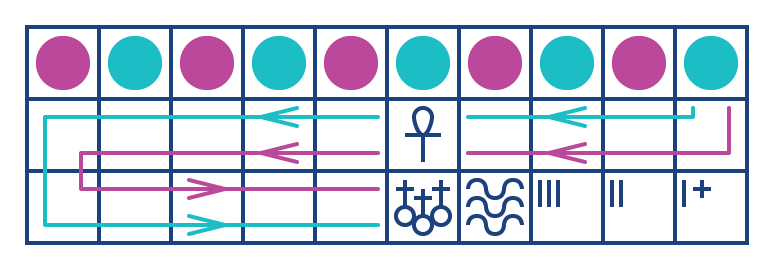
The game is played no a 10×3 board containing 6 “special” game tiles:


Return Stone
House of the Three Judges


House of Beauty
House of the Two Judges


House of Waters
House of Horus
Each player has 5 pawns, spaced out and alternating on the uppermost row.
4 casting sticks (plain on one side, coloured on the other) are rolled to generate a number between 1-5; 1-4 being represented by the number of coloured sticks facing up, with 5 being represented by all sticks being plain side up. This is the amount of spaces the player may move.
Should a player move their pawn onto a tile that is occupied by an opponent’s pawn, said pawn’s position is switched with that of the pawn that is being moved. This is negated if the opponents pawn is on one of the special game tiles above, or if the opponent’s pawns are in a group of 2 or more.
Once a pawn lands on the House of Beauty tile, the player may keep it there provided they have possible moves left for their other pawns; otherwise, they player must roll:
-5 skips all special tiles and the pawn is removed from the board.
-4 lands the pawn in the House of Horus, where a 1 is needed to complete.
-3 lands the pawn in the House of 2 Judges, which requires a 2 to complete.
-2 lands the pawn in the House of 3 Judges, which requires a 3 to complete.
-1 lands the pawn in the House of Waters. Should this happen, the pawn is moved back to the Return Stone. Should there already be a pawn on this tile, the pawn moves back further to the first available free tile.
The first player to move all their pawns from the board is the winner.
Strategy and luck go hand in hand in the playing of this game. For instance, should roll an odd number on your first roll, it is possible to block multiple of your opponent’s pawns from progressing, an option open to both competitors. Likewise, if you reach the House of Beauty first, it is possible to block you opponent from moving any pawns from the board, but can also lead to your opponent blocking your pawns from moving as a backlog ensues.
The game benefits from playing the dice (or sticks in this case) as apposed to building a strategy over multiple moves.
Overall, a fun game, but bloody infuriating.
 K00253257 - College Blog